
SEO Interview Questions to Crack Any Interview (2026)
Prepare for freshers, experienced, technical, local SEO, tools, AI Overviews, E-E-A-T, and advanced SEO interview rounds with practical answers written for real hiring discussions.
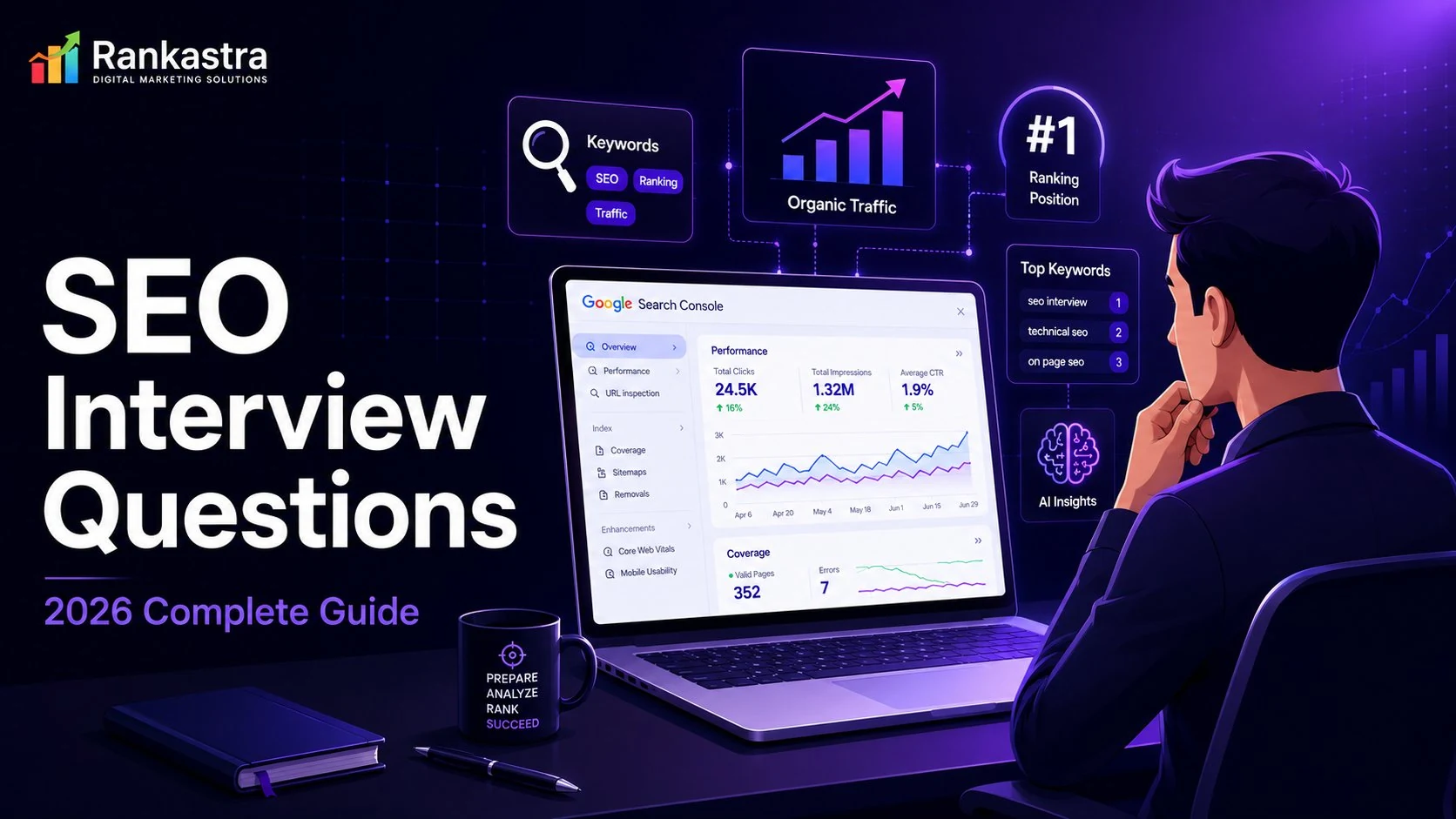
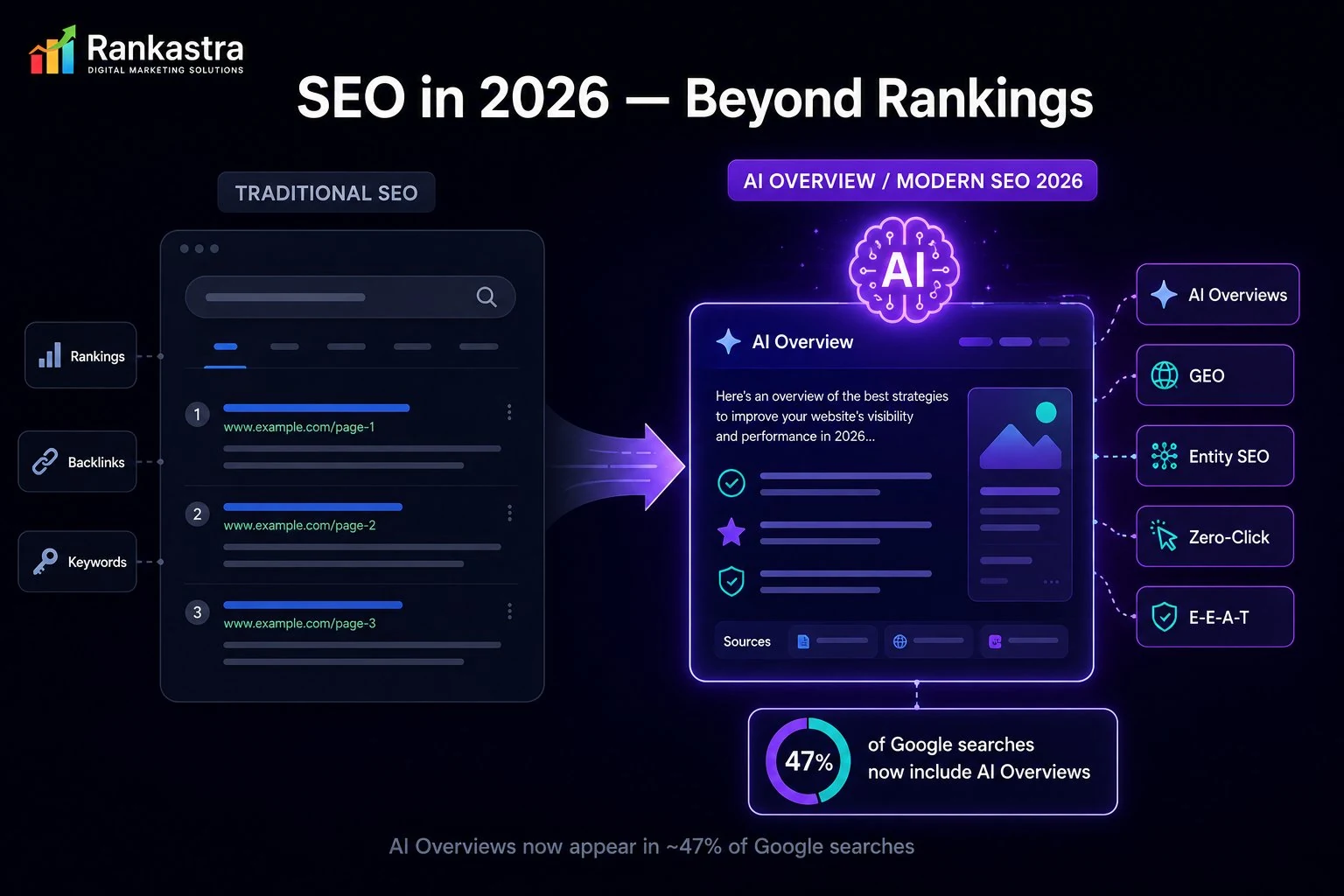
Preparing for SEO interview questions in 2026 requires more than memorising definitions. SEO is one of the fastest-growing career paths in digital marketing because every business now wants measurable visibility, qualified traffic, and search-led revenue. But SEO interviews in 2026 are very different from the old “What is SEO?” style interviews. With AI Overviews now appearing in about 47% of Google searches according to a Botify and DemandSphere study reported by Search Engine Journal, interviewers expect candidates to understand technical SEO, content quality, entities, AI search, local visibility, analytics, and business impact.
This guide covers SEO interview questions for freshers, experienced professionals, technical SEO roles, agency roles, local SEO roles, and modern AI-driven search interviews. You will find practical SEO interview questions and answers, tool-based questions, scenario-based answers, and a quick terminology reference you can revise before your interview.
How to Prepare for an SEO Interview
What interviewers actually look for in 2026
Interviewers are not only checking whether you can define SEO. They want to know whether you can think clearly, diagnose problems, explain decisions, and connect SEO work with business outcomes. A strong candidate can explain why traffic dropped, how to prioritise fixes, which pages deserve content updates, and how SEO supports leads, revenue, or brand visibility.
In 2026, SEO roles also need comfort with AI search, zero-click behaviour, Core Web Vitals, Google Search Console, content helpfulness, and entity-based optimisation. A fresher should understand fundamentals clearly. An experienced candidate should be able to explain strategy, trade-offs, and examples from real campaigns. If you are also studying generative AI interview questions, many of those concepts now overlap with modern SEO.
Must-know tools before your interview
You do not need to master every SEO tool in the market, but you should know what each tool is used for. Google Search Console helps you understand indexing, queries, clicks, impressions, CTR, page experience, and technical issues. Google Analytics 4 helps you understand user behaviour, conversions, engagement, and channel performance.
For competitive research, tools like Ahrefs, Semrush, Ubersuggest, Moz, and Similarweb are commonly discussed. For technical audits, Screaming Frog is especially useful because it crawls websites and helps identify broken links, redirects, missing metadata, canonicals, indexability issues, and sitemap problems.
How to answer SEO questions using the STAR method
The STAR method helps you answer scenario-based SEO interview questions with structure. STAR means Situation, Task, Action, and Result. Instead of saying, “I improved rankings,” explain the context, what you were responsible for, what steps you took, and what changed after your work.
For example, if asked about a traffic drop, do not jump directly to “algorithm update.” Say: “The site lost 28% organic traffic after a template change. My task was to identify whether the issue was technical, content-related, or algorithmic. I checked GSC coverage, robots.txt, canonical tags, redirects, page templates, and ranking pages. We found accidental noindex tags on blog pages, fixed them, resubmitted sitemaps, and recovered most traffic within three weeks.”
Interview preparation checklist
| Topic | What to Revise |
|---|---|
| SEO fundamentals | Crawling, indexing, ranking, SERP, organic search, paid search |
| On-page SEO | Title tags, meta descriptions, headings, internal linking, URL structure |
| Off-page SEO | Backlinks, dofollow/nofollow, link quality, toxic links, digital PR |
| Technical SEO | Canonicals, redirects, robots.txt, sitemap, Core Web Vitals, hreflang |
| Keyword research | Search intent, keyword difficulty, long-tail keywords, topical clusters |
| Tools | GSC, GA4, Ahrefs, Semrush, Screaming Frog, PageSpeed Insights |
| Google updates | Panda, Penguin, Helpful Content, March 2024 Core Update |
| AI search | AI Overviews, GEO, AEO, zero-click search, entity optimisation |
Basic SEO Interview Questions and Answers for Freshers
These basic SEO interview questions are ideal for beginners, college students, and candidates preparing for their first SEO role. They also cover the core areas usually asked in SEO interview questions for freshers and SEO interview questions and answers for freshers.
1. What is SEO?
SEO stands for Search Engine Optimization. It is the process of improving a website so that it appears higher in unpaid search results for relevant queries. SEO includes content optimisation, technical improvements, keyword research, user experience, and authority building. A good answer should mention that SEO is not just about rankings; it is about attracting the right audience and converting that traffic into business value.
2. What are the main types of SEO?
The three main types are on-page SEO, off-page SEO, and technical SEO. On-page SEO focuses on content, headings, keywords, internal links, and meta tags. Off-page SEO focuses on backlinks, brand mentions, and authority signals from outside the website. Technical SEO focuses on crawlability, indexing, speed, mobile usability, structured data, and site architecture.
3. What is the difference between organic and paid results?
Organic results are unpaid listings that appear because search engines consider them relevant and useful. Paid results are advertisements where businesses pay to appear for selected keywords. Organic SEO usually takes longer but can produce long-term traffic if maintained well. Paid search can bring faster visibility, but traffic usually stops when the advertising budget stops.
4. What is keyword density?
Keyword density is the percentage of times a keyword appears compared to the total number of words on a page. Earlier, many SEOs focused heavily on keyword density, but modern SEO is more about natural usage, intent matching, and topical depth. For example, using SEO interview questions naturally in headings, intro, and answers is better than repeating it awkwardly. A good rule is to write for users first and include keywords where they genuinely fit.
5. What are meta tags?
Meta tags are HTML elements that provide information about a webpage to search engines and users. The most important SEO-related meta tags are the title tag and meta description. The title tag can influence rankings and clicks, while the meta description mainly affects click-through rate. Other tags, such as robots meta tags, can control whether a page should be indexed or followed.
6. What is domain authority?
Domain Authority is a third-party metric created by Moz to estimate how likely a domain is to rank compared with others. It is not a direct Google ranking factor. Interviewers ask this to check whether you understand the difference between SEO tool metrics and Google’s actual systems. A strong answer should say that DA can be useful for comparison, but real SEO decisions should also consider traffic, relevance, topical authority, link quality, and business value.
7. What are backlinks?
Backlinks are links from one website to another. Search engines can treat high-quality backlinks as trust and authority signals. However, not all backlinks are equal; a relevant link from a respected industry website is far more valuable than hundreds of spammy links. In SEO interview questions and answers for freshers, you should always mention quality, relevance, and natural link acquisition.
8. What is an XML sitemap?
An XML sitemap is a file that lists important URLs on a website and helps search engines discover them. It does not guarantee indexing, but it improves discovery, especially for large websites or newly published pages. A sitemap should include canonical, indexable URLs only. You can submit it through Google Search Console to help Google understand your site structure.
9. What is robots.txt?
Robots.txt is a file placed in the root directory of a website to guide search engine crawlers. It can allow or disallow crawling of specific sections of a website. A common mistake is assuming robots.txt prevents indexing completely; if a blocked URL is linked elsewhere, it may still appear in search results without full content. For stronger index control, use a noindex tag where appropriate.
10. What is SERP?
SERP stands for Search Engine Results Page. It is the page users see after entering a query in Google or another search engine. SERPs can include organic results, ads, featured snippets, AI Overviews, People Also Ask boxes, images, videos, shopping results, and local packs. Understanding SERP features helps SEOs decide what content format is needed to win visibility.
11. What is anchor text?
Anchor text is the clickable text used in a hyperlink. It helps users and search engines understand the context of the linked page. For example, linking with “technical SEO checklist” gives clearer context than “click here.” Over-optimised anchor text can look manipulative, so natural variation is important.
12. What is the difference between indexing and ranking?
Indexing means a search engine has stored a page in its database. Ranking means the page appears in search results for a particular query. A page can be indexed but still not rank well if it lacks relevance, authority, helpfulness, or technical quality. This distinction is important in basic SEO interview questions because many beginners confuse the two.
| Type | Focus Area | Key Elements |
|---|---|---|
| On-Page SEO | Optimising content and page-level elements | Title tags, headings, content, internal links, images, schema |
| Off-Page SEO | Building trust and authority outside the site | Backlinks, brand mentions, PR, citations, reviews |
| Technical SEO | Helping search engines crawl, render, and index | Sitemaps, robots.txt, speed, redirects, canonicals, mobile usability |
On-Page SEO Interview Questions and Answers
These on page SEO interview questions test whether you understand how to optimise individual pages for users and search engines. Strong on-page SEO is the foundation of any effective SEO strategy.
1. What are the most important on-page SEO factors?
Important on-page factors include title tags, headings, content quality, keyword intent, internal links, URL structure, image optimisation, schema markup, and page experience. The page should answer the search query better than competing pages. Interviewers also expect you to mention user experience, not just keyword placement. A strong page is clear, useful, well-structured, and easy to navigate.
2. How do you optimise a title tag and meta description?
A title tag should include the main keyword naturally, match search intent, and give users a reason to click. It should usually stay within a readable length so it does not get heavily truncated in search results. A meta description should summarise the page value and encourage clicks without sounding clickbait. For example, for SEO interview questions, a good title could mention freshers, experienced candidates, and 2026 updates.
3. What is keyword cannibalization?
Keyword cannibalization happens when multiple pages on the same website target the same or very similar keyword intent. This can confuse search engines and split ranking signals across pages. To fix it, you can merge weak pages, update internal links, create clearer intent separation, or canonicalise duplicate content. The goal is to make each page serve a distinct purpose.
4. Why is internal linking important?
Internal linking helps users navigate your website and helps search engines discover and understand pages. It also distributes authority across important pages. For example, a blog about technical SEO interview questions can internally link to a technical SEO audit guide. Good internal linking uses descriptive anchor text and supports topic clusters.
5. What is an SEO-friendly URL structure?
An SEO-friendly URL is short, descriptive, readable, and aligned with the page topic. It should avoid unnecessary parameters, dates, random numbers, and confusing folder structures. For example, /blogs/seo-interview-questions is cleaner than /post?id=8892&cat=44. A good URL helps users understand the page before clicking.
6. How does content freshness affect SEO?
Content freshness matters when the topic changes over time, such as SEO trends, interview questions, salary data, Google updates, or tool features. Updating old content can improve usefulness and maintain rankings. However, freshness does not mean changing dates without improving the content. Real updates include adding new examples, correcting outdated information, refreshing screenshots, and improving answers.
7. What are header tags and why do they matter?
Header tags such as H1, H2, and H3 structure the content for readers and search engines. The H1 usually represents the main topic of the page, while H2s and H3s organise subtopics. Clear headings help users scan the page and help search engines understand topical coverage. In SEO interview questions and answers, mention that headings should be useful, not stuffed with keywords.
8. How do you optimise images for SEO?
Image SEO includes using descriptive file names, relevant alt text, compressed image size, proper dimensions, and modern formats like WebP where suitable. Alt text should describe the image for accessibility and context, not repeat keywords unnaturally. Large uncompressed images can hurt loading speed and Core Web Vitals. For content-heavy pages, image placement should support understanding, not distract from the answer.
| On-Page SEO Elements | Best Practice | Character/Length Limit |
|---|---|---|
| Title Tag | Include primary keyword naturally and match intent | Around 50–60 characters |
| Meta Description | Summarise benefit and improve CTR | Around 150–160 characters |
| H1 | Use one clear main heading | No fixed limit, keep concise |
| URL Slug | Short, readable, keyword-relevant | 3–6 words preferred |
| Image Alt Text | Describe image accurately | Keep natural and concise |
| Intro | Mention main topic early | First 100 words |
Off-Page SEO Interview Questions and Answers
These off page SEO interview questions check whether you understand authority building, link quality, and brand signals.
1. What is off-page SEO?
Off-page SEO refers to activities outside your website that improve its authority, trust, and visibility. The most common example is link building, but it also includes digital PR, brand mentions, local citations, reviews, and content promotion. Good off-page SEO should support real reputation, not manipulate search engines. Interviewers want to hear that you focus on relevance and quality over link quantity.
2. What is the difference between dofollow and nofollow links?
A dofollow link can pass link equity, while a nofollow link tells search engines not to treat the link as a standard endorsement. Google now treats nofollow as a hint rather than a strict directive in many cases. Nofollow links can still bring referral traffic, brand visibility, and credibility. A natural backlink profile usually has a mix of link types.
3. What are white hat link-building strategies?
White hat link building focuses on earning links through useful content, relationships, and legitimate promotion. Examples include digital PR, guest contributions, original research, expert quotes, broken link building, resource page outreach, and creating link-worthy assets. The key is that the link should make sense for users. Paid link schemes and irrelevant mass outreach can create long-term risk.
4. How can you improve domain authority or site authority?
You improve authority by earning high-quality backlinks, publishing expert content, improving topical depth, building brand mentions, and maintaining technical quality. You should not chase Domain Authority as the only KPI because it is a third-party score. A better goal is to improve organic visibility, referring domain quality, rankings for valuable topics, and conversions. Authority grows when your website becomes a trusted source in its niche.
5. What are toxic backlinks?
Toxic backlinks are low-quality, spammy, irrelevant, or manipulative links that may harm a website’s trust signals. Examples include links from hacked sites, link farms, spam directories, and irrelevant paid networks. Google often ignores many spammy links automatically, so disavow should not be used casually. If there is clear evidence of manipulative link building or a manual action risk, then a disavow file may be considered carefully.
6. Do social signals directly affect SEO rankings?
Social signals such as likes, shares, and comments are not direct Google ranking factors in the same way backlinks can be. However, social visibility can indirectly support SEO by increasing content reach, brand searches, referral traffic, and link opportunities. If a useful article gets shared widely, more people may discover and link to it. A balanced answer should separate direct ranking factors from indirect marketing benefits.
7. What is digital PR in SEO?
Digital PR is the process of earning media coverage, brand mentions, and backlinks through newsworthy stories, data, expert opinions, or campaigns. It is useful because it can generate links from authoritative websites that are difficult to get through normal outreach. For example, a study on Indian SEO salary trends could attract mentions from marketing blogs and career websites. Digital PR works best when the story is genuinely useful or interesting.
| Link Type | Passes Link Equity? | When to Use |
|---|---|---|
| Dofollow | Usually yes | Editorial links, genuine references, useful resources |
| Nofollow | Usually limited/hint-based | Comments, some directories, sponsored or user-generated contexts |
| Sponsored | Signals paid placement | Paid partnerships, advertorials, sponsorships |
| UGC | Signals user-generated content | Forums, comments, community posts |
| Internal Link | Passes internal signals | Navigation, content hubs, topic clusters |
Technical SEO Interview Questions and Answers
Technical SEO interview questions test whether you can diagnose how search engines crawl, render, index, and evaluate a website. This section also includes technical SEO interview questions and answers that are common for SEO analyst and specialist roles.
1. What is the difference between crawling, indexing, rendering, and ranking?
Crawling is when search engine bots discover URLs. Rendering is when search engines process the page like a browser, including JavaScript and layout elements. Indexing is when the processed page is stored in the search engine’s database. Ranking is when the indexed page is selected and ordered for a search query based on relevance, quality, authority, and user experience.
2. What is a canonical tag?
A canonical tag tells search engines which version of a page should be treated as the preferred version when duplicate or similar pages exist. It is commonly used for product pages, filtered URLs, tracking parameters, and syndicated content. A canonical tag is a signal, not an absolute command. It should point to an indexable, relevant, and equivalent page.
3. What is crawl budget?
Crawl budget refers to the number of pages a search engine is willing and able to crawl on a website within a given time. It matters more for large websites such as eCommerce stores, marketplaces, publishers, and SaaS documentation sites. Poor crawl budget management can happen because of duplicate URLs, faceted navigation, redirect chains, thin pages, and server errors. Improving internal linking, sitemaps, site speed, and indexation rules can help crawlers focus on important pages.
4. What are Core Web Vitals?
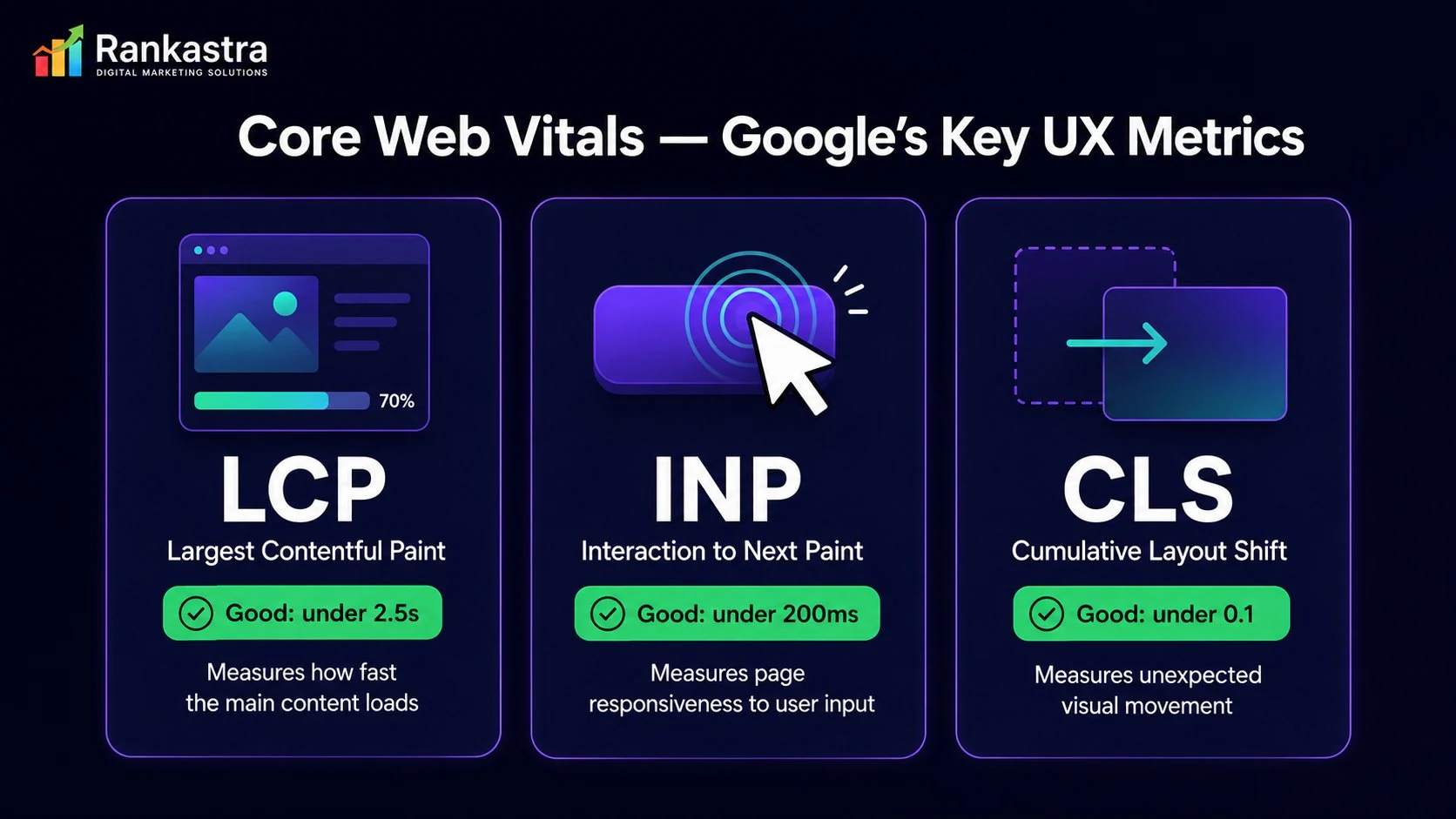
Core Web Vitals are user experience metrics that measure loading performance, responsiveness, and visual stability. Google’s current Core Web Vitals are LCP, INP, and CLS. Google recommends LCP within 2.5 seconds, INP under 200 milliseconds, and CLS below 0.1 for a good user experience. These metrics matter because slow and unstable pages frustrate users, even when the content itself is useful.
5. What is mobile-first indexing?
Mobile-first indexing means Google primarily uses the mobile version of a page for indexing and ranking. If your mobile page has less content, poor internal linking, missing structured data, or slow performance, SEO can suffer. A responsive design is usually easier to manage than separate mobile URLs. Candidates should mention that mobile usability is not optional because most users search from mobile devices.
6. What is the difference between a 301 and 302 redirect?
A 301 redirect means a URL has moved permanently, while a 302 redirect means it has moved temporarily. For SEO migrations, 301 redirects are usually used because they signal that ranking signals should transfer to the new URL. A 302 may be suitable for temporary campaigns, testing, or short-term location changes. Using the wrong redirect can confuse search engines and delay proper consolidation.
7. What is hreflang?
Hreflang is an HTML attribute used to tell search engines which language or regional version of a page should be shown to users. It is useful for international SEO when a website has versions for different countries or languages. For example, an Indian English page and a UK English page may need hreflang annotations. Incorrect hreflang implementation can cause wrong pages to rank in the wrong region.
8. What is log file analysis?
Log file analysis means reviewing server logs to understand how search engine bots crawl a website. It can show which pages Googlebot visits, how often it crawls them, and whether it is wasting time on low-value URLs. This is especially useful for enterprise SEO and large websites. Log analysis can uncover crawl traps, orphan pages, server errors, and crawl budget issues.
9. How do you diagnose indexing issues?
Start with Google Search Console to check indexing reports, URL Inspection, sitemap status, and manual actions. Then review robots.txt, meta robots tags, canonical tags, HTTP status codes, internal links, content quality, and duplication. If the page is crawlable but not indexed, the issue may be quality, duplication, weak internal linking, or low importance. A strong answer should show a step-by-step diagnostic process.
10. What is structured data in SEO?
Structured data is code that helps search engines understand page content more clearly. It can support rich results such as FAQ snippets, product information, reviews, recipes, events, and breadcrumbs. Schema markup does not guarantee rich results, but it improves machine readability. In 2026, structured data is also useful because AI systems prefer clear, consistent, well-labelled information.
| HTTP Status Code | Name | SEO Impact |
|---|---|---|
| 200 | OK | Page is accessible and can be crawled/indexed if allowed |
| 301 | Permanent Redirect | Transfers users and signals to the new URL |
| 302 | Temporary Redirect | Signals temporary movement; use carefully |
| 404 | Not Found | Normal for removed pages but bad if important URLs break |
| 410 | Gone | Strong signal that content was intentionally removed |
| 503 | Service Unavailable | Useful during temporary maintenance if configured correctly |
Keyword Research SEO Interview Questions
These digital marketing SEO interview questions test whether you understand demand, intent, competition, and business value.
1. What is your keyword research process?
I start by understanding the business model, target audience, services, products, and conversion goals. Then I collect seed keywords, competitor keywords, Search Console queries, customer questions, and SERP suggestions. After that, I group keywords by intent, difficulty, funnel stage, and page type. The final step is mapping keywords to pages so one page does not compete with another.
2. What is the difference between short-tail and long-tail keywords?
Short-tail keywords are broad terms such as “SEO” or “digital marketing.” They usually have high search volume but broad intent and strong competition. Long-tail keywords are more specific, such as “technical SEO interview questions and answers for freshers.” They often have lower volume but higher intent and better conversion potential.
3. How do you find low-competition keywords?
I look for long-tail queries, question-based keywords, underserved SERPs, weak competitor pages, forum discussions, People Also Ask questions, and Search Console impressions with low clicks. Tools like Ahrefs, Semrush, Ubersuggest, Google Keyword Planner, and AlsoAsked can help. But low competition should not be judged only by keyword difficulty. You must also inspect the SERP manually and check whether your website can realistically create a better page.
4. What are the main types of search intent?
The main intent types are informational, navigational, commercial, and transactional. Informational users want to learn, navigational users want a specific brand or page, commercial users are comparing options, and transactional users are ready to buy or act. Search intent decides content format. For example, “SEO interview questions” needs a detailed guide, while “SEO course price” may need a landing page.
5. Which keyword research tools do you use?
Common tools include Google Keyword Planner, Google Search Console, Ahrefs, Semrush, Ubersuggest, Moz, AnswerThePublic, AlsoAsked, and Google Trends. GSC is useful because it shows actual queries already bringing impressions or clicks to your site. Paid tools are useful for competitor analysis, keyword difficulty, content gaps, and backlink data. The best tool depends on budget, website size, and project goals.
6. How do you map keywords to content?
Keyword mapping means assigning target keywords to specific pages based on intent and topic. One page should usually target one primary intent and several related secondary keywords. For example, a page on SEO interview questions can include basic SEO interview questions, advanced SEO interview questions and answers, local SEO interview questions, and technical SEO interview questions if they all serve the same guide intent. Proper mapping prevents cannibalization and improves topical coverage.
| Keyword Type | Avg Volume | Competition | Conversion Potential |
|---|---|---|---|
| Short-tail | High | High | Low to medium |
| Long-tail | Low to medium | Low to medium | High |
| Branded | Varies | Low | High |
| Informational | Medium to high | Medium | Low to medium |
| Commercial | Medium | Medium to high | High |
| Local | Low to medium | Location-dependent | High |
Advanced SEO Interview Questions for Experienced Professionals
These advanced SEO interview questions and answers are useful for candidates with 2–5+ years of experience. They also fit SEO interview questions for experience and SEO interview questions and answers for 3 years experience.
1. A website’s organic traffic drops by 40%. How would you diagnose it?
First, I would identify whether the drop is sitewide, page-specific, keyword-specific, device-specific, or country-specific. Then I would compare Google Search Console clicks, impressions, average position, and indexed pages before and after the drop. I would also check recent website changes, Google updates, robots.txt, noindex tags, canonical changes, redirects, page speed, and manual actions. Only after separating technical, content, algorithmic, and demand-related causes would I recommend fixes.
2. How would you build topical authority for a new website?
I would start with a clear niche and create a topic map around core services, subtopics, questions, comparisons, and use cases. Instead of publishing random blogs, I would build content clusters that internally link to pillar pages. I would also add expert insights, original examples, structured data, author credibility, and supporting assets. Topical authority grows when a website consistently answers a subject better than scattered competitors.
3. What is entity-based SEO?
Entity-based SEO focuses on people, places, brands, products, concepts, and relationships rather than only keywords. Search engines use entities to understand meaning and context. For example, Rankastra as a digital marketing agency can be connected with SEO, web development, AI marketing, Pune, digital strategy, and client outcomes. Entity optimisation includes consistent brand information, schema, topical clarity, internal linking, citations, and mentions across trusted sources.
4. How would you create an SEO strategy for a brand-new website?
For a new site, I would begin with technical foundations: clean architecture, fast loading, indexable pages, analytics, Search Console, sitemap, and schema. Then I would research competitors, map keywords by funnel stage, create service pages, publish supporting blog clusters, and build internal links. Early SEO should focus on low-competition and high-intent topics before targeting highly competitive keywords. I would also build authority through local citations, digital PR, partnerships, and useful resources.
5. How do you measure SEO ROI?
SEO ROI is measured by connecting organic traffic with conversions, leads, revenue, pipeline value, or assisted conversions. Rankings and traffic are useful indicators, but they are not the final business outcome. For lead generation, I would track form submissions, calls, qualified leads, and CRM data. For eCommerce, I would track organic revenue, conversion rate, average order value, and customer acquisition cost.
6. What is your full SEO audit process?
My SEO audit process includes technical audit, indexation review, content audit, keyword gap analysis, backlink audit, internal linking review, SERP analysis, Core Web Vitals check, schema review, and conversion analysis. I prioritise issues based on impact, effort, and business value. For example, fixing accidental noindex tags is more urgent than rewriting a meta description on a low-traffic page. The audit should end with an action plan, not just a list of errors.
7. How does SEO strategy differ for SaaS, eCommerce, and local businesses?
For SaaS, SEO often focuses on problem-aware content, comparison pages, integration pages, use cases, and demo conversions. For eCommerce, SEO focuses on category pages, product pages, faceted navigation, schema, crawl budget, reviews, and commercial keywords. For local businesses, SEO focuses on Google Business Profile, local landing pages, reviews, citations, and local pack visibility. The core principles are similar, but page types and conversion paths are different.
8. How would you handle SEO for a large eCommerce website?
I would start with crawl control, category structure, faceted navigation, canonical rules, indexable filters, product schema, internal linking, and duplicate content. Then I would prioritise high-revenue categories and map keywords to category and product pages. Large eCommerce SEO also needs review content, stock handling rules, pagination handling, and strong page speed. The strategy should focus on revenue-driving pages first, not just total indexed pages.
E-E-A-T and Google Algorithm SEO Interview Questions
1. What does E-E-A-T mean and why was the extra “E” added?
E-E-A-T stands for Experience, Expertise, Authoritativeness, and Trustworthiness. Google added the extra “E” for Experience in its Search Quality Rater Guidelines update in December 2022. The idea is that content can be more useful when it shows first-hand experience, such as actually using a product, visiting a place, or solving a real problem. Google has also said trust is central because users need reliable results, especially for sensitive topics.
2. How can a website demonstrate E-E-A-T?
A website can demonstrate E-E-A-T through expert authors, real examples, original research, clear sourcing, transparent policies, accurate information, reviews, case studies, and strong brand reputation. For service businesses, testimonials, project proof, team credentials, and detailed service pages help build trust. For blogs, updating outdated content and citing reliable sources matters. E-E-A-T should be visible to users, not hidden behind generic claims.
3. What is Google’s Helpful Content System?
Google’s Helpful Content System was introduced to reward content made for people rather than content made mainly to attract search traffic. In March 2024, Google said helpfulness became part of its core ranking systems rather than a single standalone system. The March 2024 core update involved multiple systems and aimed to show more helpful results while reducing unoriginal, low-quality content. Candidates should connect helpful content with real usefulness, not just word count.
4. What is the difference between a Google penalty and an algorithm update?
A penalty usually refers to a manual action where Google directly flags a site for violating policies, and it may appear in Google Search Console. An algorithm update is an automated ranking system change that can increase or decrease visibility without a manual action. If traffic drops after a core update, it does not always mean the site was “penalised.” The right response is to analyse content quality, relevance, user satisfaction, technical health, and competitors.
5. Name five major Google algorithm updates and their impact.
Panda targeted low-quality and thin content. Penguin targeted manipulative link practices. Hummingbird improved Google’s understanding of meaning and conversational queries. Helpful Content pushed websites to create people-first content rather than search-engine-first content. The March 2024 Core Update strengthened helpfulness signals and introduced stronger spam policies around scaled content abuse, site reputation abuse, and expired domain abuse.
SEO Interview Questions on AI, AI Overviews and Modern Search (2026)
This is where many latest SEO interview questions are moving. Recruiters want to know whether you understand how AI is changing search behaviour, not just how to rank blue links.
1. How has AI changed SEO in 2025–2026?
AI has changed SEO by shifting search from only ranked links to generated answers, summaries, citations, and conversational discovery. Users may get answers directly in AI Overviews, ChatGPT, Perplexity, Gemini, or AI Mode before clicking any website. This means SEOs must optimise for visibility, citations, brand mentions, and trust signals, not just traditional rankings. Strong organic rankings still matter, but machine-readable expertise and entity clarity matter more than before.
2. What is Google AI Overview?
Google AI Overview is a search feature that uses generative AI to summarise answers for selected queries and show supporting sources. One major study reported AI Overviews appearing in about 47% of Google searches and occupying major screen space, especially on mobile. AI Overview activation varies heavily by query type and is especially common for informational and question-led searches. This is why modern SEO interview questions now include AI visibility and zero-click strategy.
3. How do you optimise content for AI Overviews?
To optimise for AI Overviews, create clear, well-structured, factually accurate content that directly answers user intent. Use concise definitions, step-by-step explanations, comparison tables, schema, author credibility, updated data, and internal topical depth. Pages should be crawlable, indexable, fast, and semantically close to the query being answered. The goal is not to trick AI systems but to become the clearest and most trustworthy source they can cite.
4. What is semantic search and entity optimisation?
Semantic search means search engines understand meaning, context, and relationships instead of matching only exact keywords. Entity optimisation means making people, brands, services, products, and concepts clear across your website and external profiles. For example, if a company offers SEO services in Pune, its website, Google Business Profile, schema, service pages, and citations should communicate that consistently. This helps both traditional search engines and AI systems understand the brand accurately.
5. What is GEO in SEO?
GEO stands for Generative Engine Optimisation. It focuses on improving visibility inside generative AI platforms and AI-generated answers. GEO includes structured information, credible brand mentions, strong reviews, consistent data, expert content, and authoritative citations. It does not replace SEO; it expands SEO into AI search environments where users may never visit a traditional SERP.
6. How should SEOs adapt to zero-click searches?
Zero-click searches happen when users get enough information from the SERP without clicking a result. To adapt, SEOs should track more than clicks, including impressions, brand searches, featured snippet ownership, AI citations, local pack visibility, and assisted conversions. Content should still answer questions clearly, but pages also need stronger conversion paths for users who do click. For businesses, brand recall and trust become more important when clicks are harder to earn.
7. How do you track SEO performance when AI reduces clicks?
Traditional metrics like rankings and organic sessions are still useful, but they are incomplete. I would track Search Console impressions, CTR changes, AI Overview presence, featured snippets, brand search volume, assisted conversions, lead quality, and revenue contribution. I would also monitor referral traffic from AI platforms where available. The reporting conversation should shift from “traffic only” to “visibility, influence, and business impact.”
Local SEO Interview Questions and Answers
These local SEO interview questions are useful for candidates applying to agencies, service businesses, clinics, restaurants, real estate firms, and location-based companies.
1. What is local SEO?
Local SEO is the process of improving visibility for location-based searches. Examples include “SEO agency in Pune,” “dentist near me,” or “best cafe in Baner.” It focuses on Google Business Profile, local landing pages, reviews, citations, NAP consistency, and proximity signals. Local SEO is important for businesses that serve customers in specific cities or service areas.
2. What are Google Local Pack ranking factors?
Local Pack rankings are influenced by relevance, distance, and prominence. Relevance means how well the business matches the query. Distance means how close the business is to the searcher or searched location. Prominence includes reviews, links, citations, brand authority, and overall online reputation.
3. How do you optimise a Google Business Profile?
Optimise Google Business Profile by choosing the right primary and secondary categories, adding accurate services, writing a clear description, uploading real images, adding business hours, collecting reviews, and posting updates. NAP details must match the website and citations. You should also answer questions, add products or services, and keep information updated. A neglected GBP can reduce trust and local visibility.
4. What is NAP consistency?
NAP stands for Name, Address, and Phone number. NAP consistency means the business details are the same across the website, Google Business Profile, directories, social profiles, and local citations. Inconsistent information can confuse users and search engines. For local SEO, accuracy builds trust and reduces friction.
5. What are local citations?
Local citations are online mentions of a business’s name, address, phone number, and sometimes website. They can appear on directories, industry portals, maps, review platforms, and local business listings. Citations help search engines verify business information. Quality and consistency matter more than submitting to hundreds of low-quality directories.
SEO Tools Interview Questions
1. What do you use Google Search Console for?
Google Search Console is used to monitor organic performance, indexing, page experience, search queries, clicks, impressions, CTR, and technical issues. It also helps submit sitemaps, inspect URLs, identify crawl errors, and monitor manual actions. For SEO interviews, mention that GSC shows data directly from Google. It is one of the most important tools for diagnosing real search performance.
2. What is the difference between Google Search Console and Google Analytics?
Google Search Console focuses on search visibility before the user reaches the website, including queries, impressions, clicks, indexing, and rankings. Google Analytics focuses on what users do after they land on the website, such as sessions, engagement, conversions, and revenue. GSC answers “How did we appear in Google?” GA4 answers “What happened after users visited?” Both tools are stronger when used together.
3. How do Ahrefs or Semrush help in competitor analysis?
Ahrefs and Semrush help identify competitor keywords, backlinks, top pages, content gaps, ranking changes, and paid search activity. They are useful for understanding what competitors rank for and where they earn authority. However, tool data should be validated with manual SERP analysis and business judgement. A keyword is not valuable just because a competitor ranks for it.
4. How do you use Screaming Frog for SEO audits?
Screaming Frog crawls a website and shows technical SEO data at scale. I use it to find broken links, redirects, duplicate titles, missing meta descriptions, canonical issues, noindex tags, thin pages, image problems, and internal linking depth. It is especially useful for migration checks and large-site audits. When connected with GSC, GA4, and PageSpeed Insights, it becomes even more powerful.
5. What tools would be in your daily SEO stack?
My daily stack would include Google Search Console, GA4, Screaming Frog, PageSpeed Insights, Ahrefs or Semrush, Google Sheets, Looker Studio, and a rank tracker. For local SEO, I would add Google Business Profile and citation tracking tools. For content planning, I might use AlsoAsked, Google Trends, and SERP analysis. The best stack depends on whether the role is agency, in-house, eCommerce, SaaS, or local SEO.
| Tool | Primary Use | Free/Paid | Best For |
|---|---|---|---|
| Google Search Console | Search performance and indexing | Free | Every SEO role |
| Google Analytics 4 | User behaviour and conversions | Free | Reporting and ROI |
| PageSpeed Insights | Speed and Core Web Vitals | Free | Performance checks |
| Screaming Frog | Technical SEO crawling | Free/Paid | Audits and migrations |
| Ahrefs | Backlinks and competitor research | Paid | Link and keyword analysis |
| Semrush | SEO, PPC, content, competitors | Paid | Full digital marketing analysis |
| Ubersuggest | Keyword and competitor research | Free/Paid | Beginner-friendly research |
| Looker Studio | Dashboards and reports | Free | Client and management reporting |
| Google Business Profile | Local business visibility | Free | Local SEO |
SEO Terminology Quick Reference — Know These Before Your Interview
| SEO Term | Full Form / Meaning | One-Line Definition |
|---|---|---|
| SERP | Search Engine Results Page | The page shown after a user searches on Google or another search engine. |
| DA | Domain Authority | Moz metric estimating a domain’s ranking strength. |
| PA | Page Authority | Moz metric estimating a specific page’s ranking strength. |
| CTR | Click-Through Rate | Percentage of impressions that result in clicks. |
| DR | Domain Rating | Ahrefs metric showing backlink strength of a domain. |
| KD | Keyword Difficulty | Estimate of how hard it may be to rank for a keyword. |
| TF-IDF | Term Frequency-Inverse Document Frequency | Method for understanding word importance in a document set. |
| LSI | Latent Semantic Indexing | Commonly used SEO term for related words, though often misused technically. |
| E-E-A-T | Experience, Expertise, Authoritativeness, Trustworthiness | Quality concept used in Google’s rater guidelines. |
| LCP | Largest Contentful Paint | Measures loading performance of the largest visible content element. |
| CLS | Cumulative Layout Shift | Measures unexpected visual movement during page load. |
| INP | Interaction to Next Paint | Measures page responsiveness after user interaction. |
| CWV | Core Web Vitals | Google’s key user experience metrics: LCP, INP, CLS. |
| GSC | Google Search Console | Google tool for monitoring search performance and indexing. |
| GBP | Google Business Profile | Business profile used for local visibility on Google Search and Maps. |
| NAP | Name, Address, Phone | Core local business details used in local SEO. |
| GEO | Generative Engine Optimisation | Optimising visibility in AI-generated search answers. |
| AEO | Answer Engine Optimisation | Optimising content to answer questions directly in search and AI systems. |
| XML Sitemap | URL list for crawlers | File that helps search engines discover important pages. |
| Robots.txt | Crawler instruction file | File that guides bots on what they can or cannot crawl. |
| Canonical | Preferred URL signal | Tag that tells search engines the preferred version of similar pages. |
| Hreflang | Language/region signal | Attribute used for international page targeting. |
| Schema | Structured data vocabulary | Markup that helps search engines understand page content. |
| Anchor Text | Clickable link text | Text users click when following a hyperlink. |
| Crawl Budget | Crawl capacity and demand | Number of pages search engines crawl within a time period. |
Frequently Asked Questions About SEO Interviews
Are SEO interviews technical?
Yes, SEO interviews can be technical, especially for SEO analyst, technical SEO, eCommerce SEO, and experienced roles. Freshers may be asked basic SEO interview questions, while experienced candidates may face questions on crawling, indexing, redirects, Core Web Vitals, JavaScript SEO, and log file analysis. Even content-focused SEO roles need basic technical understanding. You do not need to be a developer, but you should understand how websites work.
How many rounds are there in an SEO interview?
Most SEO interviews have two to four rounds depending on the company. A typical process includes HR screening, technical SEO or digital marketing round, practical assignment, and final manager or founder discussion. Agencies may test your ability to handle multiple clients and explain strategy clearly. In-house companies may focus more on business impact, reporting, and cross-team collaboration.
What is the salary of an SEO executive in India?
SEO executive salaries in India vary by city, company size, skills, and experience. Recent Glassdoor India listings commonly show average base pay around the lower five-figure monthly range for SEO Executive roles, with variation by city and employer. Freshers may start lower, while candidates with strong technical SEO, content strategy, analytics, and client communication skills can earn more. Salary also improves faster when you can show measurable business results, not just task completion.
What should a fresher know before an SEO interview?
A fresher should know what SEO is, how search engines work, the difference between on-page, off-page, and technical SEO, and how to use basic tools like Google Search Console and Google Analytics. They should understand keywords, meta tags, backlinks, sitemap, robots.txt, internal links, and search intent. SEO interview questions and answers for freshers usually test clarity, not deep enterprise experience. If you can explain concepts with simple examples, you will stand out.
Do I need coding knowledge for an SEO job?
You do not need advanced coding for most SEO jobs, but basic HTML, CSS, and JavaScript understanding is helpful. Knowing how title tags, headings, canonical tags, schema, links, and status codes work can make you much stronger. For technical SEO roles, coding knowledge becomes more important because you may work with developers on rendering, speed, templates, and structured data. Even basic coding confidence can improve your communication with web teams.
What is the difference between SEO Executive, SEO Analyst, and SEO Manager roles?
An SEO Executive usually handles execution tasks such as keyword research, on-page updates, reporting, link tracking, and basic audits. An SEO Analyst goes deeper into data, technical issues, competitor analysis, Search Console insights, and performance diagnosis. An SEO Manager owns strategy, prioritisation, team coordination, client communication, reporting, and business outcomes. The higher the role, the more important decision-making and communication become.
How long does it take to become good at SEO?
You can learn SEO basics in one to three months, but becoming genuinely good usually takes one to two years of hands-on practice. SEO requires testing, analysis, patience, and exposure to real websites. You need to see how rankings change, how technical issues affect traffic, and how content performs over time. The fastest way to improve is to work on a live website and track results consistently.
What are the latest SEO trends interviewers ask about in 2026?
The latest SEO interview questions in 2026 often cover AI Overviews, GEO, AEO, zero-click search, entity optimisation, E-E-A-T, topical authority, Core Web Vitals, and content quality after Google’s helpfulness-focused updates. Interviewers may also ask how you measure SEO when clicks decline but visibility increases. Candidates should understand that SEO is no longer only about ranking links. It is about being discoverable, trusted, cited, and chosen across search engines and AI platforms.
Conclusion
SEO interviews in 2026 reward candidates who can explain both fundamentals and modern search changes with confidence. Revise the basics, practise technical SEO interview questions, prepare examples from real or practice projects, and learn how AI Overviews, E-E-A-T, local SEO, and tools fit into current SEO work. The best preparation is to practise your answers out loud. When you can explain SEO clearly, practically, and with business context, you become much easier to hire.
Need help with your website?
Get in touch with the Rankastra team — we’re here to help you build, optimise, and grow.