
How to Get Your Website Cited in Google AI Overview: Complete Guide
Learn how Google AI Overview selects sources, why citation is different from ranking, and how to structure your content, schema, E-E-A-T, and topic clusters for stronger AI search visibility.

Introduction
Google AI Overviews now appear on 48% of all searches as of April 2026, according to BrightEdge tracking. For SEO teams and business owners, learning how to get cited in Google AI Overview is no longer a future tactic — it is a current search visibility requirement.
Google AI Overview is an AI-generated answer block that appears at the top of Google Search for selected queries. It is powered by Google’s Gemini models and synthesizes information from multiple indexed sources, showing supporting citation links alongside the generated summary.
Getting cited matters because user behavior is shifting fast. According to Search Engine Land’s report on Seer Interactive data, informational queries with AI Overviews saw a 61% drop in organic CTR since mid-2024. The same data showed that brands cited inside AI Overviews earned 35% more organic clicks than uncited competitors on the same SERP.
This guide explains how Google AI Overview selects sources, the six signals that determine citation, how to structure content for AIO, how to apply E-E-A-T and schema, how to build topical authority, and how to track your AI Overview SEO performance month over month.
What Is Google AI Overview and How Does It Select Sources?
Google AI Overview selects sources by retrieving relevant pages from Google’s index and then filtering for passages that are extractable, verifiable, and trustworthy. Traditional ranking helps, but citation is decided more by passage quality, content freshness, schema clarity, and topical coverage than by ranking position alone.
How the AIO Citation Process Works
The citation process runs in two stages: retrieval and synthesis.
In the retrieval stage, Google’s systems narrow the open web to a shortlist of candidate pages based on query relevance. In the synthesis stage, the AI picks passages from those pages whose answers are clean, complete, and trustworthy enough to quote inside the AIO panel.
A key insight: ranking and citation are not the same. According to Ahrefs’ 2026 study of 863,000 SERPs, only 38% of AI Overview citations came from URLs ranking in the top 10 — down from 76% in mid-2025. A page at position eight can beat a position-one result for citation if it answers the query more directly and clearly.
Google also uses fan-out queries, meaning it evaluates your content against related sub-questions you may not be directly tracking. If your article only answers the headline keyword but ignores related subtopics, it will score lower on semantic completeness — one of the six core citation signals covered next.
AI Overview vs Featured Snippet — What Is the Difference?
Many SEOs treat AI Overview optimization the same as featured snippet optimization. They are related but need different strategies.
| Feature | Featured Snippet | Google AI Overview |
|---|---|---|
| What it shows | Single extracted paragraph, list, or table from one source | AI-generated summary combining multiple sources |
| Sources cited | One page | Typically 3–8 pages |
| Click behavior | Higher direct click rate to the single source | Lower CTR overall; citation clicks are more qualified |
| Ranking requirement | Usually top 5 organic results | 38% of cited URLs rank outside the top 10 |
| Schema impact | Moderate — helps structure extraction | Higher — Article, FAQ, HowTo, and Organization schema improve trust signals |
| Optimization approach | One clear answer per page targeting one query | Semantic completeness across all subtopics + E-E-A-T + entity consistency |
The practical difference is that featured snippet optimization focuses on one clean answer for one query. AI Overview optimization requires building topic-wide authority, structured trust signals, and extractable passages across the full subject.
The 6 Core Signals Google Uses to Decide Who Gets Cited
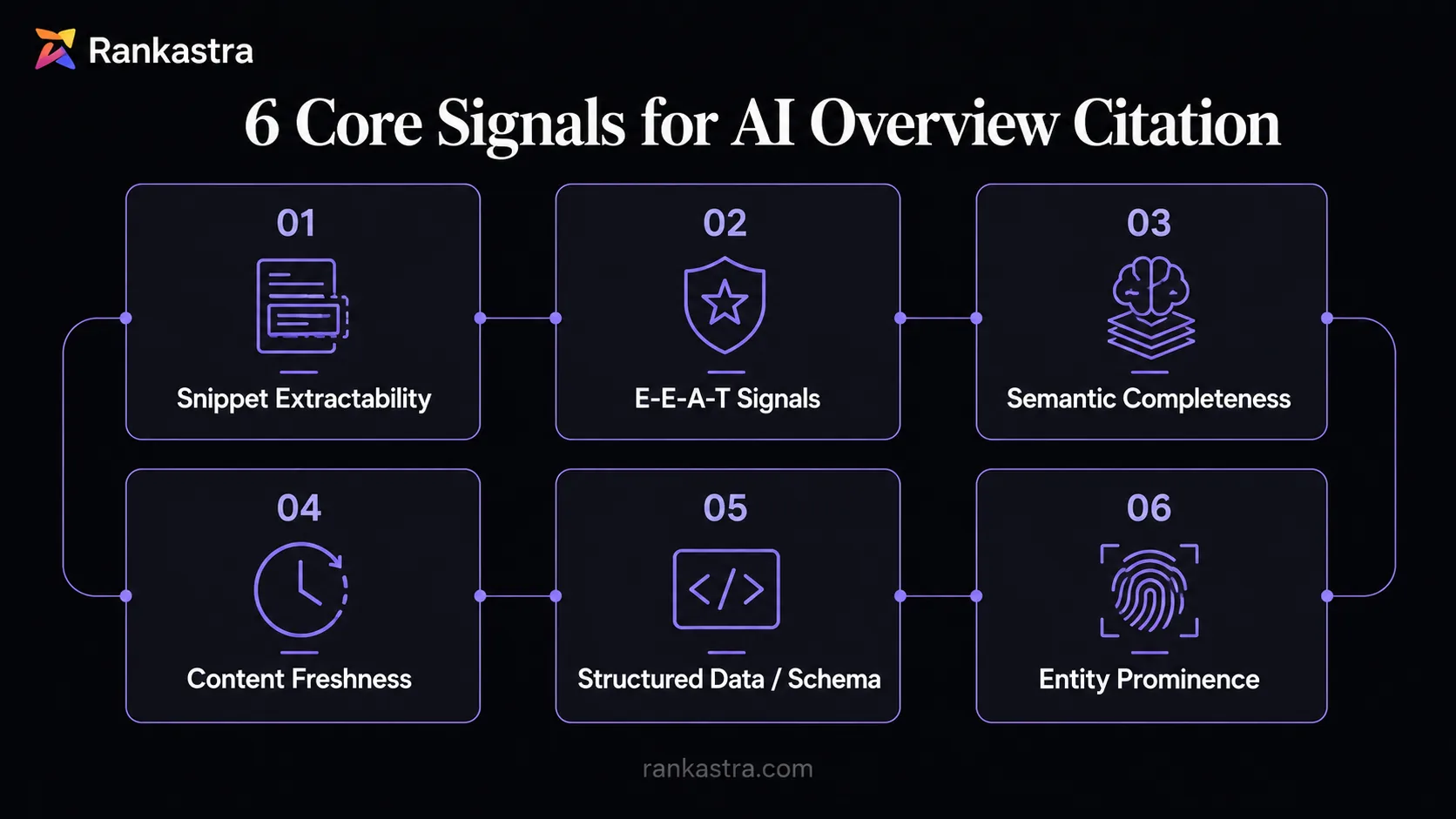
Google’s AI Overview citation decisions are based on six measurable signals: snippet extractability, E-E-A-T, semantic completeness, content freshness, structured data, and entity prominence. Pages that score well across all six are significantly more likely to be selected as citation sources.
1. Snippet Extractability
Extractability means your content can be quoted cleanly, without needing surrounding context to make sense. Google AI extracts content in blocks of roughly 130–160 words. Each block must stand alone as a complete answer.
- Open every H2 section with a direct, complete answer in 40–60 words
- Keep paragraphs under 3–4 lines
- Avoid starting sections with long setups before the actual answer
- Use numbered lists for steps, bullets for features, and tables for comparisons
2. E-E-A-T Signals
According to research cited by SEOwithSiva, 96% of pages cited in Google AI Overviews show strong E-E-A-T signals. Google’s AI prioritizes sources that demonstrate real expertise, visible authorship, and brand trustworthiness.
- Author name, role, and credentials visible on the article
- Link to author LinkedIn or company profile
- First-hand experience language: “in our testing,” “based on our client work”
- Original data, case observations, or client experience references
- Clear business contact details
3. Semantic Completeness
Semantic completeness means your page answers the full topic, not just the main keyword. Because Google uses fan-out queries, it tests your content against related questions you may not be directly targeting.
An article on how to get cited in Google AI Overview should cover source selection mechanics, content structure, schema, E-E-A-T, topical authority, tracking, and common mistakes — not just define AIO. Think of the article as a complete answer hub.
4. Content Freshness
Content freshness matters because AI search evolves quickly. Search Engine Land’s AI Overview optimization guidance notes that a significant share of AIO citations comes from recently published or updated content.
- Review and update every 60 days
- Update statistics, source names, and tool references
- Add new Search Console or Google guidance changes
- Replace outdated references from 2023 or early 2024
- Add a “Last updated” date at the top of the article
5. Structured Data (Schema)
Schema markup gives Google cleaner context about your article, author, FAQs, steps, and organization. It does not guarantee AI Overview citation, but it improves extraction clarity and supports trust signals when paired with strong content.
Search Engine Journal has warned that schema should not be treated as an AI citation shortcut. Best schema stack: Article or BlogPosting, FAQPage, HowTo (where genuine steps exist), Organization, and BreadcrumbList.
6. Entity Prominence
Entity prominence means Google can clearly identify your brand, authors, and topical focus across the web. Your business name, logo, website URL, contact details, and service descriptions should match across your website, Google Business Profile, LinkedIn, social profiles, and schema markup.
Inconsistent entity signals reduce AI trust in your content as a reliable source. Organization schema with sameAs links connecting your brand to official profiles helps establish a clear entity map.
How to Structure Your Content for AI Overview Citation
To structure content for AI Overview citation, make every major section easy to extract, verify, and quote. Start with a direct answer, use question-based headings, back claims with named sources, and organize all related subtopics in one complete article. The goal is to help Google understand both the answer and why your content deserves to be cited.
The Answer-First Writing Framework
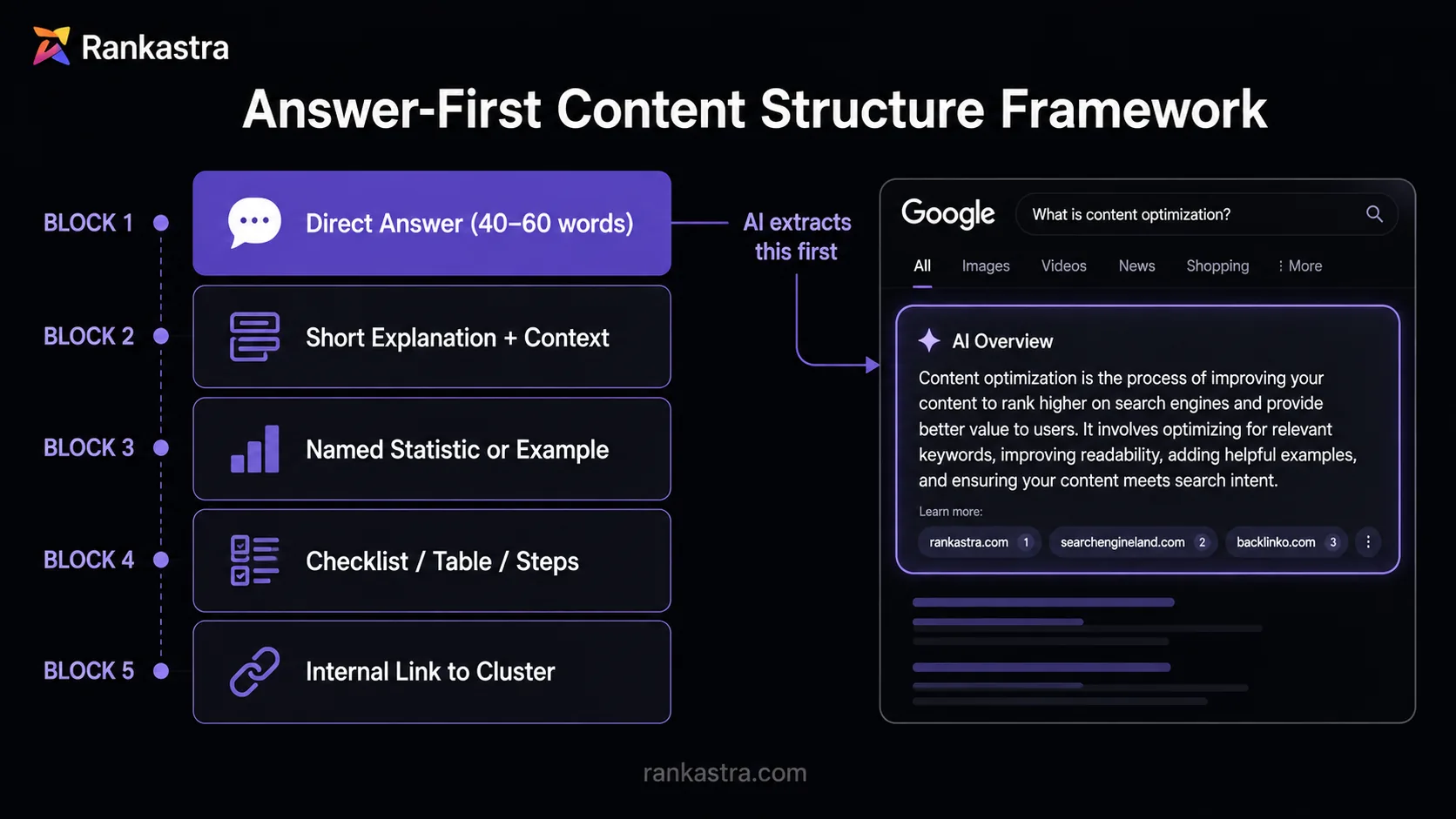
The answer-first framework means every H2 section opens with a complete, standalone answer in 40–60 words — before any explanation, context, or examples.
Do not open a schema section with: “Many marketers are confused about technical SEO.” Open with: “Schema markup helps Google understand your article, FAQs, how-to steps, author, and organization.”
- Direct 40–60 word answer to the heading question
- Short explanation with supporting context
- Practical example or named statistic
- Checklist, table, or step list where useful
- Internal link to a related article in the topic cluster
Use Headings as Questions
Question-based headings help AI systems match your content to real search intent. Instead of “Schema Benefits,” write “Does Schema Help You Get Cited in Google AI Overview?” After each question-style heading, answer immediately.
Back Every Claim with a Named Source
Named sources make your content easier to trust and easier for AI systems to verify. According to Stackmatix research, named statistics increase AI visibility by 22%, and expert quotes increase AIO selection probability by 37%.
Format: “According to [Source + Year], [specific statistic or finding].” Specificity gives your article more weight than generic SEO advice and makes individual passages more citable.
E-E-A-T: Building the Trust Signals AI Looks For
E-E-A-T helps Google decide whether your page deserves to support an AI-generated answer. Trust is demonstrated through real authorship, visible expertise, firsthand experience, original data, consistent brand information, and proof that your business is recognized beyond its own website.
Author Attribution and Credentials
Every article should show a real author or expert team with clear credentials, linked to a LinkedIn profile or company page.
Recommended author block for Rankastra articles:
Rankastra Team — Digital Marketing & SEO Experts
Rankastra is a digital marketing agency based in Pune, India, helping businesses with SEO, performance marketing, content strategy, marketing automation, and website growth.
Authorship matters more in 2026 because the web now has more AI-written content than ever. Search engines need stronger signals to identify who is behind the advice and whether it reflects real expertise.
First-Hand Experience Markers
Use phrases like “In our SEO audits, we noticed…”, “Based on Rankastra’s client work…”, or “In our content testing…” — only when true. Original insights are content AI cannot easily find elsewhere, which increases citation probability.
Brand Entity Consistency
Your company name, logo, address, and service descriptions should match across your website, Google Business Profile, LinkedIn, social profiles, author profiles, and schema markup.
This is foundational for AI-driven marketing visibility across Google and other answer engines. Add Organization schema with sameAs links connecting to official social profiles.
Schema Markup — The Technical Edge for AI Citation
Schema markup helps Google understand your article structure, author details, FAQ answers, how-to steps, and organization identity. It does not guarantee AI Overview citation, but gives search systems cleaner context. For WordPress websites, Rank Math makes schema setup straightforward without custom coding.
The 4 Must-Have Schema Types
- Article or BlogPosting: Identifies title, author, publisher, and dates. Supports trust and freshness signals.
- FAQPage: Marks FAQ sections as structured question-answer content for users and AI systems.
- HowTo: Best for genuine step-by-step content like “how to add schema using Rank Math.”
- Organization: Connects your brand with its logo, website, social profiles, and contact details.
How to Add Schema Using Rank Math (Step-by-Step)
- Install and activate the Rank Math SEO plugin in WordPress.
- Open the blog post in the WordPress editor.
- In the Rank Math sidebar, open the Schema tab.
- Select “Article” or “BlogPosting” as the main schema type.
- Fill in Article Name, Description, Author, Published Date, and Modified Date.
- Add FAQPage schema using the Rank Math FAQ block inside the editor.
- Add HowTo schema if the article includes a genuine step-by-step process.
- Confirm Organization schema is active in Rank Math’s global settings.
- Test the page with Google’s Rich Results Test before publishing.
- Fix any missing or invalid fields flagged in the test.
Do not add schema for content not visible on the page. Google’s systems compare structured data with actual page content, so hidden markup can reduce trust.
Topical Authority and Internal Linking for AIO
Topical authority helps Google understand that your website covers a subject deeply, not randomly. To get cited in Google AI Overview consistently, build a connected cluster of articles around your main theme and link them naturally. One strong pillar article helps, but a well-linked topic cluster builds stronger entity coverage.
Build a Topic Cluster Around Your Main Theme
Google’s fan-out queries evaluate your content across related subtopics. One article on AI Overview SEO is not enough on its own. A practical topic cluster for Rankastra:
- Pillar: How to Get Your Website Cited in Google AI Overview (this article)
- Supporting: How to Add FAQ Schema Using Rank Math
- Supporting: E-E-A-T Checklist for Indian Business Websites
- Supporting: AI Overview SEO vs Traditional SEO
- Supporting: How to Track AIO Citations in Google Search Console
- Supporting: What Is GEO and How Is It Different From SEO?
Internal Linking Rules
Use descriptive anchor text like “AI Overview SEO checklist” or “Rank Math schema setup.” Avoid “click here” or “read more.” Add 2–3 internal links per article. For a practical example of content strategy in action, see Rankastra’s WordPress website creation guide.
Common Mistakes That Stop Your Content from Being Cited
Most websites miss AI Overview citations not because of bad content, but because of avoidable structural and technical mistakes. The most common issues are buried answers, weak trust signals, outdated statistics, missing schema, vague claims, and slow mobile pages.
- Burying the answer after a long introduction instead of leading with it
- Publishing thin content under 800 words on complex topics — consistently skipped
- Using outdated content, especially 2023 articles on fast-changing AI search topics
- Inconsistent brand signals across website, Google Business Profile, LinkedIn, and social profiles
- Missing Article, FAQPage, HowTo, Organization, or Breadcrumb schema
- No author attribution or visible credentials
- Vague claims without named data sources or publication dates
- Creative headings that do not match real user questions
- FAQ sections answering generic questions with no search demand
- Slow mobile pages — AI retrieval agents move to faster sources during crawl
- Copying competitor outlines without adding original data or expert insight
- Tracking only rankings while ignoring AIO presence and brand mentions
How to Track and Monitor Your AI Overview Citations
You can track AI Overview citations through Google Search Console patterns, manual incognito checks, and dedicated AI visibility tools. Search Console does not provide a standalone AIO citation report, so combine data analysis with manual testing and third-party tools for a reliable monthly view.
Google Search Console
Search Engine Land reported in June 2025 that AI Mode clicks and impressions are included in Search Console Performance reports under the Web search type. However, Search Engine Journal confirmed GSC does not isolate AIO citation status. Track: rising impressions with falling CTR, sudden CTR drops on informational keywords, and brand queries with unusual impression growth.
Manual Incognito Testing
Every month, test your top 30–50 target queries in incognito mode. Track these fields:
| Field | What to Record |
|---|---|
| Query | Exact keyword tested |
| Date | Testing date |
| AIO Triggered | Yes or No |
| Your Site Cited | Yes or No |
| Cited Competitors | Domains in the AIO |
| Citation Position | First, middle, last, or behind expansion |
| Content Gap | What the cited page answered better |
| Action Required | Update, schema, FAQ, internal link, or new post |
AIO Tracking Tools
| Tool | Free / Paid | Key Feature | Best For |
|---|---|---|---|
| Google Search Console | Free | Query, click, impression, and CTR tracking | Baseline SEO and AIO impact monitoring |
| Semrush AI Toolkit | Paid | AI visibility and brand mention tracking | Agencies managing multiple clients |
| Otterly.AI | Paid | AI search monitoring across Google, ChatGPT, and Perplexity | Cross-platform AI visibility tracking |
| Profound | Paid | Enterprise AI answer visibility and share-of-voice | Larger brands and enterprise SEO teams |
| SerpApi | Paid / API | SERP data extraction for custom AIO dashboards | Technical SEO teams and developers |
Your AIO Citation Action Checklist (Before You Publish)
Before publishing, verify your article is easy to extract, technically sound, current, trustworthy, and connected to your broader topic cluster.
- Content opens with a direct answer in the first 100 words
- Every H2 section opens with a 40–60 word standalone answer block
- All major claims backed by named statistics with source and year
- Author bio with credentials and LinkedIn link visible on page
- Article + FAQPage + HowTo schema added and validated via Rank Math
- Organization schema implemented with sameAs social links
- FAQ section added using PAA-sourced, real search questions
- Mobile page load time under 3 seconds
- Content published or updated within the last 60 days
- Brand entity consistent across website, GMB, LinkedIn, and social
- Internal links to 2–3 related articles in the topic cluster
- Monthly AIO citation tracking set up via GSC + manual testing
- Content includes original examples, agency observations, or client data
- Top cited competitors checked manually for structure and content gaps
FAQs About Google AI Overview Citation
How long does it take to get cited in Google AI Overview?
+Getting cited in Google AI Overview can take a few weeks to several months depending on crawl frequency, content quality, schema setup, and domain trust. Pages with fresh updates, clear answer blocks, FAQPage schema, and strong internal linking tend to see results faster. AIO citations are dynamic and can appear, disappear, and rotate between sources — track changes monthly.
Does my website need to rank #1 to get cited in AI Overviews?
+No. According to Ahrefs’ 2026 study of 863,000 SERPs, only 38% of AI Overview citations came from pages ranking in the top 10 — down from 76% in mid-2025. Google may cite a lower-ranking page if it answers fan-out sub-questions better, has cleaner extractable passages, or provides stronger E-E-A-T than higher-ranking competitors.
What type of content gets cited most in Google AI Overview?
+Google AI Overview most commonly cites content with direct answers upfront, question-based headings, full subtopic coverage, named statistics, and clear author trust. Step-by-step guides, FAQ sections, comparison tables, and updated expert-led articles perform well because they are easy for AI systems to extract, verify, and quote.
Does schema markup guarantee AI Overview citations?
+No. Google’s AI Search guidance confirms no special markup is required for generative AI inclusion. Search Engine Journal reported schema should not be sold as an AI citation shortcut. Use schema to clarify content structure, author, organization, FAQs, and steps — not as a guaranteed ranking signal.
Can a new or low-authority website get cited in AI Overview?
+Yes, but it requires more work. New websites can get cited for niche queries, local topics, original research, or tutorials where stronger domains have thin content. Focus on entity consistency, author credibility, answer-first structure, FAQPage schema, and external brand mentions. A topic cluster of related supporting articles also improves citation probability.
How do I check if my website is being cited in Google AI Overview?
+Check target queries manually in incognito mode and note whether Google shows an AIO with your site cited. Cross-reference with Search Console by looking for rising impressions with falling CTR. For scale, use Semrush AI Toolkit, Otterly.AI, or Profound to track AI citation status across your full keyword set.
How does Google AI Overview affect my organic traffic?
+AI Overview can reduce overall organic traffic when users get answers directly on the SERP. According to Search Engine Land’s report on Seer Interactive data, organic CTR fell 61% for informational queries with AI Overviews since mid-2024. However, being cited protects visibility — cited brands earned 35% more organic clicks than uncited competitors, and cited users tend to be more qualified.
Need help getting cited in AI Overviews?
Get in touch with the Rankastra team — we help you build authority, structure content, and improve AI search visibility.